
Cedar County Arrest Court Records
After a Cedar County arrest, the person is booked into local custody before the court case is created. The Cedar County Prosecuting Attorney reviews reports from law enforcement and decides what charges to file. Once charges are entered as a public case, Missouri Case.net and the Cedar County Circuit Clerk become the main sources for court records after the arrest. The Circuit Clerk page identifies Sarah Turner as the Circuit Clerk and Keeper of the Records for the local court.
The jail and court systems answer different questions. The custody side may show booking date, arresting agency, bond, holds, and release status in jail inmate records. The court side shows filed charges, docket entries, hearings, judgments, and dispositions when the case is public. Booking photos and image-display limits are a separate roster issue covered with jail mugshots. A jail charge and a filed court charge can differ because the prosecutor may amend, reduce, dismiss, or add counts after reviewing the arrest report.
Search Cedar County Court Records
Missouri Case.net is the statewide public case-search portal linked from the Cedar County Circuit Clerk page. For Cedar County criminal matters, it is the best online starting point for public court records after a jail arrest. A search may show the defendant name, case number, charge entries, docket activity, hearings, judgments, and disposition information. Older, sealed, expunged, juvenile, or confidential matters may not appear online and may require direct clerk contact.
The Missouri Case.net portal is the official source shown in the screenshot below.
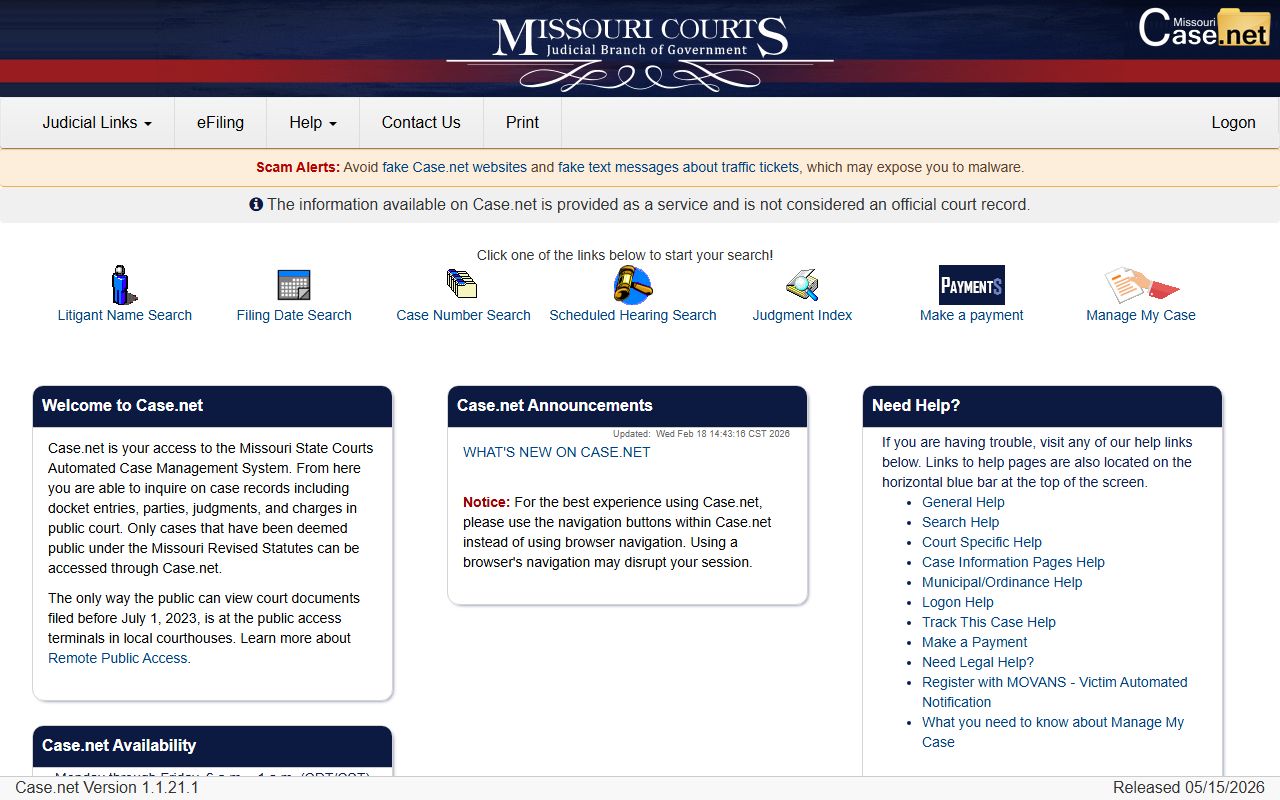
Use Case.net for the court case, not for a live custody confirmation or a booking photo. If a person was arrested but no public case appears, the prosecutor may not yet have filed charges, the case may be nonpublic, or the search terms may not match the court's record.
| Case.net Search Field | Best Use | Notes for Cedar County Arrest Cases |
|---|---|---|
| Litigant Name Search | Search by defendant name. | Useful when only the arrested person's name is known. Name spelling and aliases can affect results. |
| Case Number Search | Search by court case number. | Best when a docket number appears on paperwork, Case.net notices, or clerk correspondence. |
| Filing Date Search | Search by a known filing date or range. | Helpful when the arrest date is known but the name search returns too many results. |
| Track This Case | Follow later case activity. | Official court materials describe email alerts and optional text reminders for supported cases. |
Circuit Clerk Access and Local Court Records
The Cedar County Circuit Clerk receives criminal cases along with civil, domestic, probate, small claims, and other court filings. The clerk also records hearings, swears witnesses, coordinates jurors, and handles court fees. For court records after an arrest that do not appear in Case.net, the clerk's office is the local records office to contact. The office is listed at 113 South Street, PO Box 665, Stockton, MO 65785, phone 417-276-6700 ext. 230 or ext. 234, fax 417-276-5001. Published hours are 7:30 a.m. to 4:30 p.m., Monday through Friday, closed most state and federal holidays.
The Cedar County Circuit Clerk page identifies the local records office and links to Case.net, VINE, court forms, and related court information.
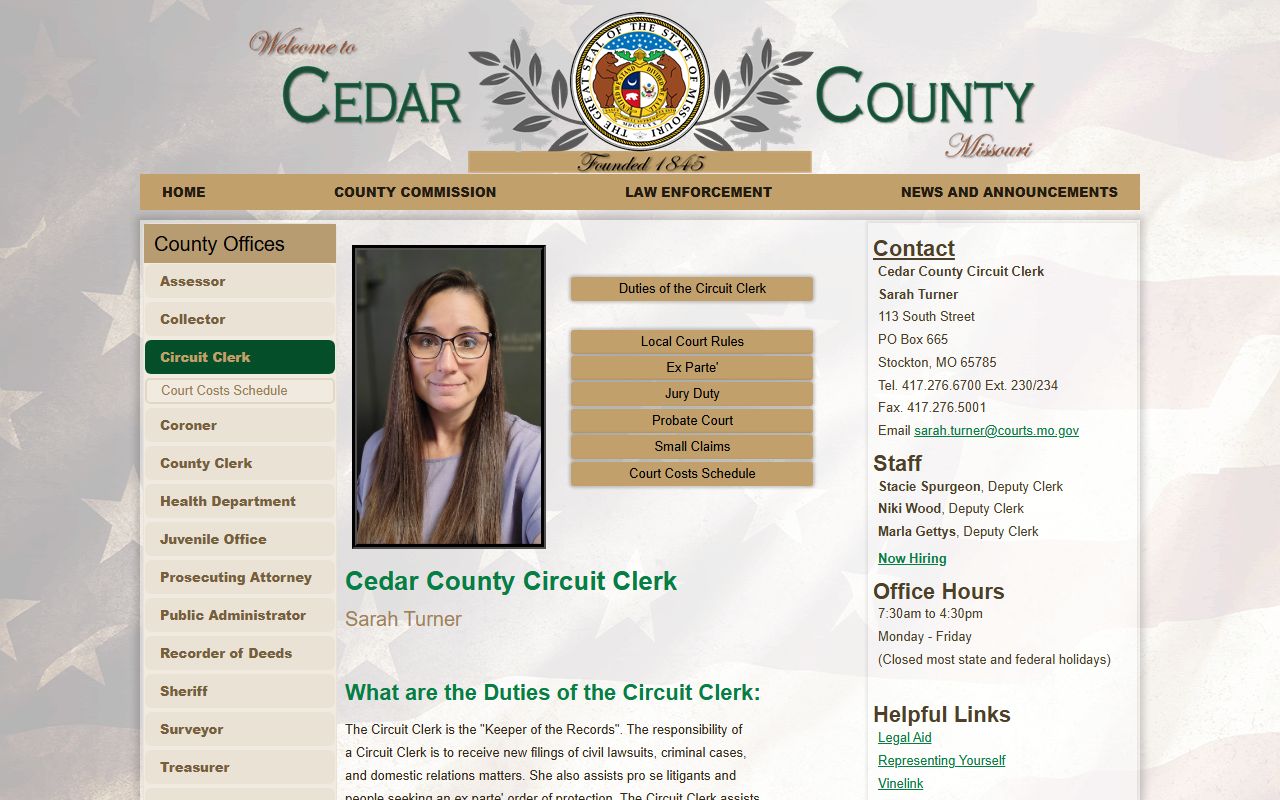
When asking about a court record, give the defendant name, date of birth if available, arrest date, filing date, case number, and charge information if known. The clerk can explain record access and copies.
How Charges Get Filed After an Arrest
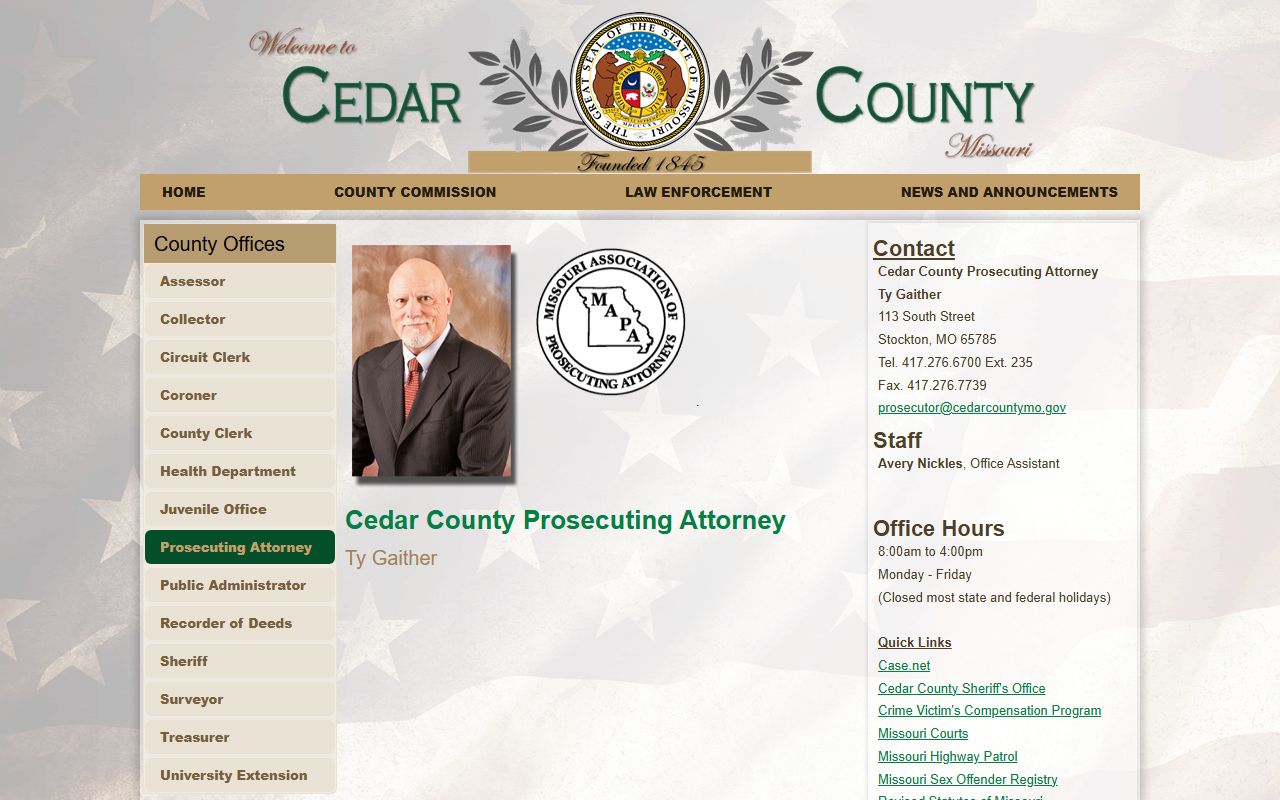
The jail arrest and booking happen first. The prosecutor's filing decision turns the arrest into a court case. Cedar County Prosecuting Attorney Ty Gaither is the local prosecutor, with an office at 113 South Street in Stockton, phone 417-276-6700 ext. 235. Published hours are 8:00 a.m. to 4:00 p.m., Monday through Friday, closed most state and federal holidays.
The Cedar County Prosecuting Attorney page is the official local source for prosecutor contact details and links to Case.net, VINE, Missouri courts, and Missouri statutes.
A charging document can start the court record even when the original jail booking entry used different wording. The table below keeps the focus on the document type, not on guilt or final outcome.
| Document | Who Uses It | What It Does | Why It Matters After Arrest |
|---|---|---|---|
| Complaint | Law enforcement or prosecutor, depending on the case path. | States the alleged offense and supports the start of a criminal case. | May appear early after booking while the case is being reviewed. |
| Information | Prosecutor. | Formally charges an offense in court without a grand-jury indictment. | Often reflects the prosecutor's filed charge rather than the jail's initial booking label. |
| Indictment | Grand jury. | Accuses a person of an offense through the grand-jury process. | Can replace or shape the formal court charges after the arrest investigation. |
Charge Status in Court Records After Arrest
Charge status matters because a court record is not frozen at arrest. The prosecutor may file fewer charges than the jail record showed, amend a count, reduce an offense level, dismiss a charge, or proceed to judgment. Case.net may show status through docket entries, charge lines, hearing results, judgments, and dispositions.
| Status or Entry | Plain Meaning | How to Read It |
|---|---|---|
| Filed or Pending | The charge has been entered and the case is still moving. | Check upcoming hearings, bond orders, and later docket entries before treating it as final. |
| Amended | The filed charge or count changed after the initial filing. | Compare the current charge line with earlier docket entries and booking information. |
| Reduced | The offense level or charge changed to a less serious filed offense. | Look for a plea, amended information, or prosecutor entry explaining the change. |
| Dismissed | The charge ended without a conviction on that count. | Review whether other counts remain pending or were resolved separately. |
| Judgment or Disposition | The court entered a result for the case or charge. | This is the closest public entry to the final court outcome when visible. |
| Closed, Sealed, or Confidential | The public record may be limited or unavailable online. | Contact the Circuit Clerk because Case.net may not show all restricted records. |
Cedar County Arrest Bond Orders
Missouri release conditions are governed by RSMo 544.455. For a bailable offense, a judge may release a person on personal recognizance unless recognizance will not reasonably assure appearance. If more conditions are needed, the court may order surety bond, cash in lieu of surety, reporting, travel or residence limits, custody with a supervising person or organization, electronic monitoring, house arrest, or other appearance-related conditions. Cedar County did not publish an official online bond-payment page in the researched sheriff or jail materials, so payment method and acceptance should be confirmed with the Sheriff's Office or Circuit Clerk before money is brought in.
| Release Term | What It Means | Cedar County Checkpoint |
|---|---|---|
| Recognizance | Release based on a promise to appear and follow conditions. | Read the court order and future hearing dates in the case record. |
| Cash Bond | Cash is required under the judge's release order. | Confirm payment instructions locally before attempting to post it. |
| Surety Bond | A surety or bail agent backs the appearance obligation. | Confirm whether the court order allows surety and whether any holds remain. |
| Electronic Monitoring or House Arrest | Release may include monitoring, location limits, or cost rules. | Check the written court order for conditions and responsible agency. |
| Hold or No-Bond Situation | Another warrant, agency hold, probation/parole matter, or court order may block ordinary release. | Use the court, sheriff, or holding agency to learn what must be resolved. |
Warrants Connected to Court Records and Arrest
No official Cedar County sheriff active-warrant database was located on the county site. Warrant questions should use official channels: the Cedar County Sheriff's Office non-emergency or jail line at 417-276-5133, the Cedar County Circuit Clerk at 417-276-6700 ext. 230 or ext. 234, and Missouri Case.net for public case entries where a warrant, return, hearing, or charge status is visible. Sheriff James "Jimbob" McCrary's office operates the Cedar County Law Enforcement Center / Detention Center, so jail-side hold questions should start there. An arrest warrant authorizes arrest on a criminal matter. A bench warrant comes from a judge, often for failure to appear or a court-order violation. A search warrant authorizes a search and is not the same thing as an arrest warrant. A fugitive or hold warrant may keep a person in jail for another jurisdiction.
Charges vs. Convictions
An arrest and a filed charge are accusations, not proof of guilt. Court records after an arrest may be public even when the case is pending, dismissed, amended, or resolved without a conviction. A conviction usually follows a guilty plea, a finding of guilt, or a verdict. Reading the final disposition matters because a public charge line by itself does not answer whether the person was convicted.
| Point of Comparison | Charge | Conviction |
|---|---|---|
| Stage | Filed allegation after prosecutor review. | Final or resolved finding after plea, verdict, or judgment. |
| Record Meaning | Shows what the state accused the person of committing. | Shows that the case ended with guilt on that count. |
| Can Change | May be amended, reduced, dismissed, or replaced. | May be affected later by appeal, expungement, or other court order. |
| How to Verify | Read current charge lines and docket entries. | Read the judgment, sentence, and disposition entries. |
Sealed vs. Expunged Arrest Records
Missouri public-access rules favor open records, but not every arrest or court case stays visible. RSMo 610.140 governs expungement for eligible Missouri arrest, plea, trial, and conviction records. Juvenile, sealed, expunged, confidential, and some older records may be unavailable in Case.net or may require clerk review. If a record has been closed or expunged by court order, use that order with the agency that holds the record.
| Point of Comparison | Sealed or Closed | Expunged |
|---|---|---|
| Public Visibility | Public access is limited by rule, statute, or court order. | Eligible records are closed under the expungement statute and order. |
| Online Search Effect | Case.net may omit the case or show limited information. | Public display may be removed or restricted after the order is processed. |
| Who Can Confirm | The Circuit Clerk or record-holding agency. | The court that issued the expungement and the agencies listed in the order. |
| Practical Step | Ask the clerk whether the record is public before assuming it does not exist. | Use the signed court order when asking agencies to update or restrict records. |
Missouri Arrest Records Law
The Missouri Attorney General Sunshine Law page explains custodian duties, written requests, and public-record request guidance for Missouri public bodies.
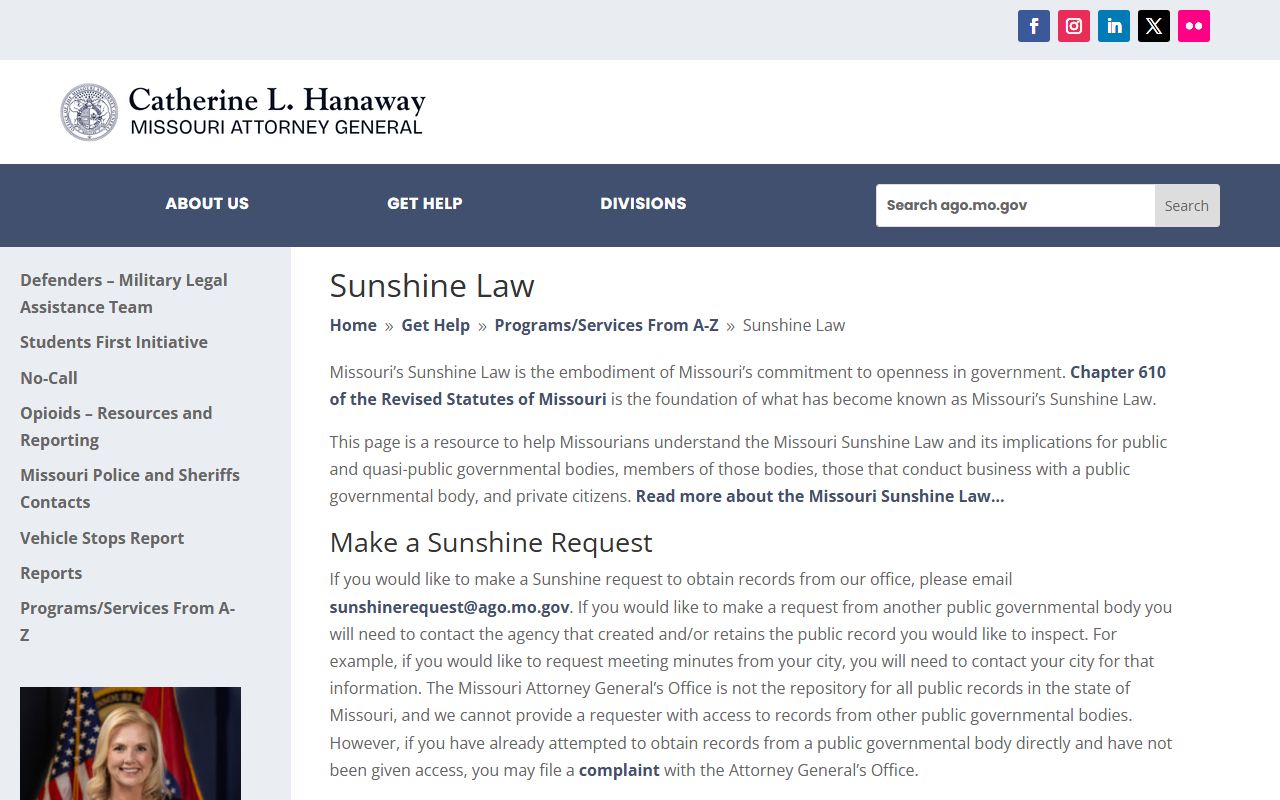
Use Sunshine Law requests for records held by the agency that created or keeps them. Jail booking and arrest materials generally start with the Sheriff's Office, while filed criminal-case records start with Case.net and the Circuit Clerk.
Key Missouri provisions:
RSMo 610.011 states Missouri's policy favoring open public records and strict construction of exceptions.
RSMo 610.023 requires public bodies to have records custodians and act on requests as soon as possible, no later than the third business day unless more time is justified.
RSMo 610.100 defines arrest and incident reports and makes those reports open records with exceptions and closure rules.
RSMo 610.140 provides the Missouri expungement process for eligible criminal records.
RSMo 544.455 governs recognizance, bond, monitoring, reporting, and other release conditions for bailable offenses.
FCRA notice: This private website is not a consumer reporting agency and must not be used for employment, credit, tenant, insurance, or other FCRA-covered screening.